 About GamePeople



Search for games
Why we're different
Come again?
Ways to thumb our pages
Never miss a beat
 RSS
RSS
 Email
Email
 Twitter
 Facebook
Console Game Reviews
Wii (MotionPlus) (Wii-Ware)Handheld Game Reviews
3DS DS (DSi-Ware)Game Genres
(Overview) Adventuring Fighting Minigames Platforming Rhythm Improving Shooting Racing Sporting StrategyMulti-player Styles
(Overview) Assistance Competitive Co-operative Shared-screen Split-screenSingle-player Styles
(Overview) Augmented Reality Dating games First Person Meta-games Physical Real-time Single Player Campaign Third Person Turn Based 3D
Subscribe to the Family Gamer column: RSS or
 Newsletter.

Format:
DS
Genre:
Strategy
Style:
Turnbased
Singleplayer
Competitive
Buy/Support:
Support Andy, click to buy via us...


Other GamePeople columnists have reviewed this from their perspective - huh?:
Family Gamer (DS)
Reluctant Gamer (DS)
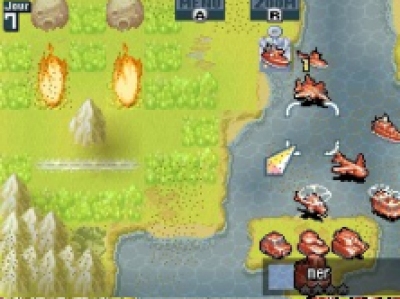
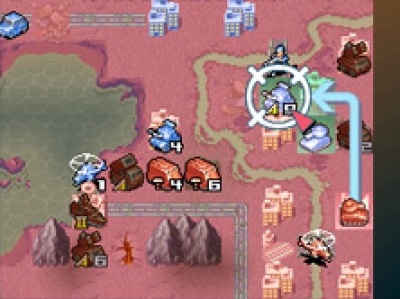
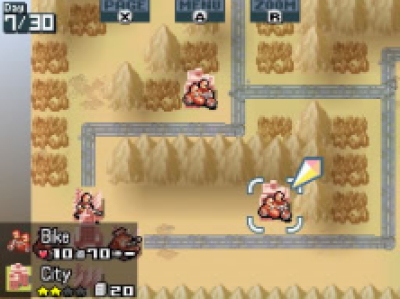
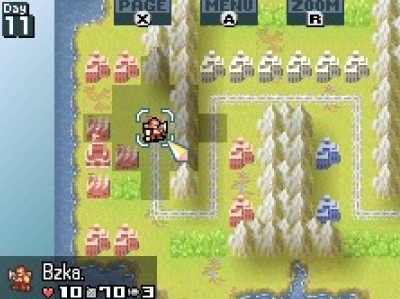
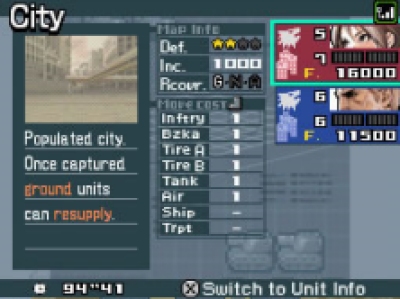
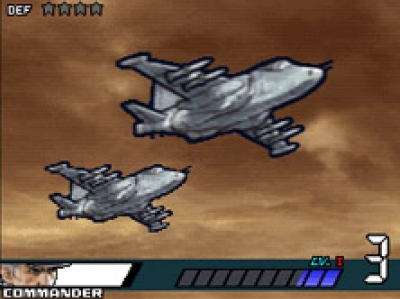
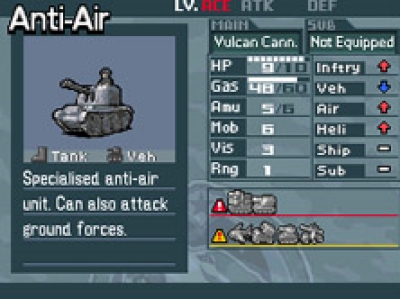
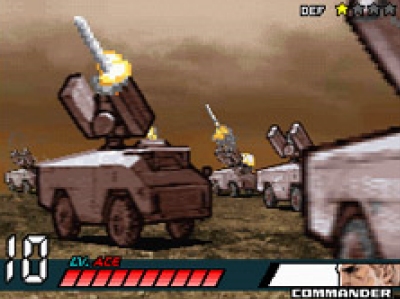
Advance Wars started life back on the original 90's Gameboy as Gameboy Wars. But it wasn't until the Gameboy Advance that the game really came to maturity.
Its offering of turn based tactics in a bright and brilliant handheld game was soon snapped up. The DS versions have extended the experience with more screen space for stats, units and terrain. Advance Wars: Dark Conflict takes the series in a darker, yet more simplistic direction.
Turn based strategy games are the video gaming equivalent of chess, risk and other board games. The player is presented with a tile based environment and a number of pieces which they can position and move. These games usually revolve around some military conflict.
When the player directs an encounter to take place the comparative stats of vehicles, characters and current landscape are used to calculate the winner. Forest usually makes you harder to hit, whilst tanks do more damage than infantry.
Advance Wars' take on turn based strategy is considerably more restrained when compared to other turn based video games. Rather than use the novelty of animated visuals and large arsenals of weapons the focus here is on balance and precision. Levels often fit on a single screen, and the number of units can often be counted on your fingers. A limited set of environment tiles are distinctive and well balanced, each area giving appropriate line of sight, movement, offensive or defensive bonuses.
Within this restrained world there is a game as complex as chess. As the turns unfold, detailed strategies are employed by the player to maximise the use of their limited resources. For experienced players, the resulting levels become puzzle-like spaces in which to play. This results in high replay value as experts aim to complete each level with a perfect score.
Players are often drawn to Advance Wars by its bright visuals and cheery gameplay. There is perhaps no greater sense of power in video gaming than watching your tank merrily bounce its way into an enemy city and come away victorious. Advance Wars: Dark Conflict provides an experience that builds a degree more seriousness into proceedings. It has a darker palette and an even more honed set of play options.
But more than all this, the simple attraction of the game is its ability to absorb you into a miniature world. Hours are lost, the day ends and the evening draws in, and all the while the Advance Wars player is in the bliss of the battle.
As just mentioned, battles in Advance Wars can last many hours. from the outset it often looks like an easy win is possible, but before too long the determined enemies are making life difficult and drawing proceedings out into a full evening's play. On top of this the desire to replay levels and achieve those elusive quick decisive victories can further extend play sessions.
Younger players are likely to struggle to grasp the forward thinking concepts required to progress with Advance Wars. Those that are comfortable playing Chess and Risk should feel more at home. In fact Advance Wars represents a good training ground for these other games.
Intermediate players will quickly get to grips with the basics of the game and appreciate just how much there is to do here. The initial simplicity gives way to a nuanced and complex game. Multiplayer mode may suite these players well, particularly if they don't have the time to invest in the substantial campaign mode.
Expert players will enjoy wringing every last ounce of fun from Advance Wars. From learning the ideal unit type and terrain combination to implementing complex pincer movements, there is always something more to do. They too will have the time required to really get to grips with the more refined aspects of play.


 RSS | Newsletter
Share this review:
RSS | Newsletter
Share this review:
Andy Robertson writes the Family Gamer column.
"Videogame reviews for the whole family, not just the kids. I dig out videogame experiences to intrigue and interest grownups and children. This is post-hardcore gaming where accessibility, emotion and storytelling are as important as realism, explosions and bravado."
Here are the games I've been playing recently:
© GamePeople 2006-13 | Contact | Huh?

|
Family Video Game Age Ratings | Home | About | Radio shows | Columnists | Competitions | Contact
With so many different perspectives it can be hard to know where to start - a little like walking into a crowded pub. Sorry about that. But so far we've not found a way to streamline our review output - there's basically too much of it. So, rather than dilute things for newcomers we have decided to live with the hubbub while helping new readers find the columnists they will enjoy. |
Our columnists each focus on a particular perspective and fall into one of the following types of gamers:
|
 Artistic Reviewers
 Family Reviewers
 Thinking Reviewers
 Specialist Reviewers